Real estate website design for agents, brokerages, commercial firms and rental operators. Live listings, proper search, and enquiries that reach you while the buyer is still interested.
Good real estate website design starts from an awkward fact. Almost every buyer and tenant now starts on a portal. By the time they reach your website they are checking whether you are worth dealing with, and whether you have anything the portal did not show them.
At Wisdom Apex Digital we build property websites that answer both questions fast. Our real estate website design is measured on viewings booked and valuations requested, not on how the homepage looks in a pitch.
Real estate website design is a search problem before it is a design one, and real estate web design that forgets this produces a brochure. Filter by area, price, bedrooms and type. Save what you like. Book a viewing without a phone call. Get those four right and the rest is presentation.
We work with individual agents, brokerages, commercial firms, property managers and short-term rental operators. The real estate website design follows how that business actually earns rather than a template, which is what separates a real estate web design agency from a general studio.
A beautiful listing page with a buried contact form is the most common failure in this industry, and it is expensive every single day.
So our real estate website design builds the enquiry journey first and decorates afterwards. Every property page has an obvious next step, every form reaches you immediately, and nothing asks a buyer to telephone during office hours.
Every real estate website design build covers all of this. None of it is an extra discovered after launch.
Every real estate website design we deliver has filters by area, price, bedrooms, type and status, with map search, sorting and results that load instantly rather than reloading the page each time someone adjusts a slider.
This is where real estate website design is won. A buyer who cannot narrow a hundred listings to five leaves for the portal that let them.
Real estate agent website design lives on the detail page. Full galleries, floorplans, virtual tours, EPC and specification data, local area information, school and transport context, and an enquiry route visible without scrolling.
Registered buyers save properties and receive alerts the moment something matching appears. This turns a one-off visitor into a contact you own, which is the main advantage real estate website design has over a portal.
Viewing booking tied to your diary, plus instant valuation request forms, the single highest-value lead an agency website produces.
Realtor website design means every agent gets a page with their own listings, specialisms, areas covered and contact details, with enquiries routed to the right person automatically.
Real estate website design is mobile design first. Property search is image heavy and most of it happens on a phone. We build lean, fast real estate websites to Google's Core Web Vitals rather than heavy layouts that stall on a gallery.
The feature every agent asks about first, and the one most agencies get wrong.
IDX pulls live listings from your shared listing system onto your own website under your own branding. Without it you are retyping properties by hand and your site is out of date within a week.
With it, an IDX real estate website keeps the buyer on your domain through the whole search instead of handing them to a portal that sells the lead back to you. That is the entire commercial argument for owning a property website at all.
Our real estate website design builds IDX real estate websites with search and filtering that match your market, listings that update automatically, saved searches tied to registered buyers, and lead capture at the point of interest rather than at the end.
A real estate website builder with IDX bolted on afterwards usually produces slow pages search engines cannot read. We integrate the feed into the site rather than embedding someone else's search in a frame, so your property pages can actually rank.
Where your market has no shared feed, the real estate website development includes a listing manager so your team adds and updates properties directly.
Each type of property business earns differently, and our real estate website design follows that rather than forcing one layout across all of them.
Sales and lettings on enquiry rather than instant booking. Real estate agent website design is about search, saved properties, viewing requests and valuation leads.
Website design for realtors works best when the valuation request is the most visible thing on the site, and realtor web design that hides it leaves money on the table.
Real estate broker websites need agent profiles, fair lead routing and a brand that works whether a buyer arrived through the firm or through one agent. Real estate website design companies often get this balance wrong.
Individual agents get their own page and listings without fragmenting the brokerage site.
Commercial real estate website design serves a slower, analytical buyer. Floorplans, specifications, lease terms, yields and location data matter more than photography.
Fewer visitors, far larger transactions, so commercial real estate website design has to get the detail exact.
Property management website design needs tenant portals, maintenance reporting and owner statements alongside the public listings.
Most of the value sits behind the login rather than on the marketing pages.
Launching a development means selling off plan: site plans, unit availability, specifications, reservation forms and construction updates for buyers who have already committed.
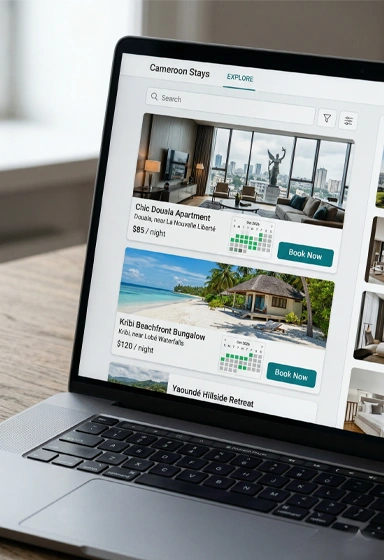
Holiday lets and serviced apartments need instant booking rather than enquiry forms, with live availability and payment taken on the site.
That is a different engine, covered in full below.
Rentals that take bookings rather than enquiries need a booking engine, and that changes the whole build.
This is the one part of real estate website design that replaces a platform rather than complementing it. Listing platforms are good at reach and expensive at everything after it. Every booking carries a commission, and the guest belongs to the platform rather than to you. A direct booking site changes that arithmetic, and vacation rental website design is where the saving comes from.
Listing pages with high-quality photo galleries, detailed descriptions, amenity lists, location maps, house rules and guest reviews. Guests already know how to read an Airbnb listing, so we use that familiarity rather than inventing a layout they have to learn.
A calendar that updates the moment a booking is confirmed, preventing double bookings and giving guests instant visibility of open dates across every property.
Guests browse, check availability and complete the booking without calling, emailing or messaging you. The whole process runs start to finish on its own, which is what separates a rental website that earns from one collecting enquiries you answer three hours late.
We integrate PriceLabs intelligent pricing, which adjusts nightly and weekly rates automatically by demand, seasonality, local events and market conditions. The same approach the major hospitality platforms use, raising income with no manual rate management on your part.
Full integration with Stripe, PayPal and other trusted gateways. Guests pay by card or online payment and funds go straight into your account with no platform commission deducted.
Booking confirmation, pre-arrival instructions, check-in details and post-stay review requests sent automatically, so every guest gets professional, timely communication without hours of manual messaging.
If you run several properties, a central dashboard covers every listing, booking, calendar and revenue figure in one place rather than scattered across platforms.
An integrated review system builds the social proof guests rely on, and the whole booking flow is built mobile first because most travel searches happen on a phone.
Portals outrank you on national terms. Local and long-tail property search is where an agency actually wins.
Real estate website design and search work together, and real estate SEO is a local discipline. Nobody beats the portals for a generic property search, but area pages, property-type pages and neighbourhood guides are winnable and they bring buyers who are already choosing where to live.
A real estate SEO company earns its fee on local visibility, Google Business Profile, reviews and the area content portals cannot be bothered to write properly. As a real estate SEO agency we would always start there rather than chasing national rankings you will not get.
For agents, valuation requests are the highest-value lead on the site, so we build content and search around sellers as deliberately as around buyers. Marketing for realtors works when the site answers what a seller wants to know before they pick up the phone.
Our full SEO services cover ongoing work for property businesses that want enquiries to keep growing after launch.
Every real estate website design project runs through the same five stages with clear checkpoints. Most property sites launch in six to ten weeks depending on listings and integrations.
Your market, your stock, your competitors and the systems you already run. If you have an existing site we audit where it loses enquiries.
Property structure, filters, area pages and the keyword map behind them. For rentals this is where booking rules, minimum stays and deposits get agreed.
Homepage, search results, property detail, agent and enquiry pages designed and approved before build. The real estate website design takes final shape here, and two rounds of revisions are included.
Development, listing feed or IDX integration, booking engine and payments where needed, tested with real listings on real devices.
Migration, analytics, search setup, training so your team can manage listings, then two years of maintenance included.
If three of these describe your current site, new real estate website design will do more than any advertising.
A real estate website redesign rebuilds search, listings and speed while keeping the area content and search visibility you already hold. It is the same real estate website design process applied to an agency that already has stock.
We audit first and say honestly which you need. Sometimes the structure is sound and the real problem is that nobody can find it.
Real estate website design cost depends on how many listings you carry, whether you need an IDX or MLS feed, how many agents need profiles, and whether bookings or payments are involved. A single-agent site sits well below a brokerage with lead routing or a rental operator with a booking engine. Every real estate website design project includes build, integration, training and two years of maintenance, with a fixed quote after discovery. Tell us about your agency.
IDX pulls live listings from your shared listing system onto your own website under your branding, so properties stay current without anyone retyping them. If your market has a shared feed your real estate website design almost certainly needs it, because without it the site is out of date within a week and buyers go back to the portal. We integrate the feed into the site properly rather than embedding someone else's search in a frame, so your property pages can still rank.
Yes, and this is the main advantage your website has over a portal. Registered buyers save searches and receive alerts when matching properties appear, which turns an anonymous visitor into a contact you own and can market to directly.
Yes. Vacation rental website design is a different build from an agency site because it takes bookings rather than enquiries. You get live availability, instant booking, dynamic pricing through PriceLabs, secure payments, automated guest messaging and a multi-property dashboard, with no platform commission on bookings taken through your own site.
For sales and lettings, almost certainly, since that is where buyers start. The point of your own site is not replacing them but capturing the buyers who found you there, building a contact list, and winning the local and valuation searches portals do not target. For short-term rentals the calculation is different, because every platform booking carries a commission your own site does not.
Yes. Where there is no listing feed we build the listing manager into the site so your team adds properties, uploads photographs, updates prices and marks things sold without touching code. Training and documentation are included.
Yes. Commercial real estate website design is a different job from residential: specifications, floorplans, lease terms, yields and tenancy details matter more than photography, and the buyer researches for far longer. Fewer visitors, much larger transactions, so the data has to be right.
Six to ten weeks of real estate website design and build for most property sites. Brokerages with many agents, IDX integration or a booking engine run toward twelve. Feed integration and booking rules take longer to agree than people expect, which is why we settle them before design starts.
Search foundations are built in: clean structure, fast loading, property schema and area pages targeting local searches. You will not outrank the portals nationally and nobody will, but local area and valuation searches are winnable. For ongoing growth we offer full SEO services.
We scope the real estate website design to the agency you actually run. A two-person office does not need brokerage architecture, and real estate website builder platforms are worth considering at the very smallest end. Simplified packages and flexible payment plans are available, and we will tell you honestly if fixing your current site serves you better this year than replacing it.
Tell us about your agency, your stock and your market, and whether you need real estate website design, vacation rental website design, or both. You will get an honest assessment of your current site, a realistic timeline, and a fixed quote before anything starts.