Ecommerce website design and development on Shopify, WooCommerce, or a bespoke build. Fast, searchable e-commerce websites designed around the one number that matters: how many visitors actually check out.
A beautiful ecommerce store that converts at 0.4% is a failure. A plain one converting at 3% pays your salary. Our ecommerce website design builds for the second outcome and makes it look good along the way.
At Wisdom Apex Digital we provide ecommerce website design and development for retailers who need the store to earn its keep. Every decision in the ecommerce website design, from category structure to the number of fields in checkout, is made against conversion rather than taste. That is what separates an ecommerce website design company from a general web shop.
Every ecommerce business is different, so we work on Shopify, WooCommerce, and fully custom builds. The platform follows the business, never the other way round, and we will tell you plainly when the cheaper platform is the right answer. As an ecommerce web design company we are paid for the outcome, not the licence.
Whether you are launching your first product or replatforming a catalogue of twenty thousand, our ecommerce web design services cover strategy, design, build, integration, and the ongoing work after launch. Full ecommerce solutions rather than a design handed over as a set of files.
Most failing stores are not ugly. They are slow, confusing to navigate, and ask for too much information at checkout.
That is where we start. Before any design work, we look at how people move through your current store, where they drop out, and what the data says they were trying to do.
Custom website design for ecommerce begins with that evidence, not with a moodboard. Cart abandonment sits near 70% across the industry according to Baymard Institute's ongoing research, and most of it is fixable with better checkout design rather than more traffic.
Our ecommerce website design services cover all of this as standard. None of it is an optional extra discovered after launch, and the same list applies whether we are building e-commerce websites from scratch or rebuilding yours.
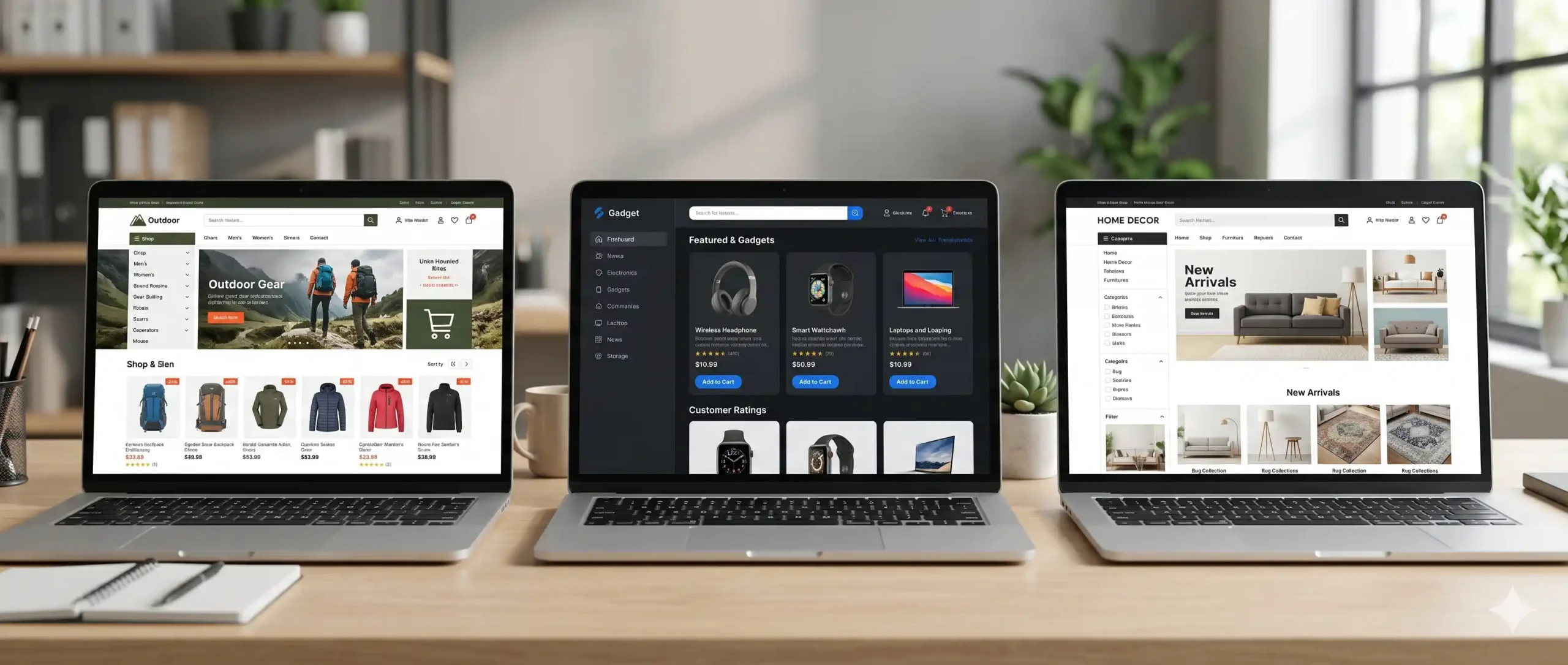
When we build an ecommerce website, category pages carry most of the commercial value in the online store design, and most of the search traffic. We structure them around how customers actually browse rather than how your warehouse is organised.
Product pages get the gallery, specification, stock, variant, and review treatment they need to answer every question before someone has to email you. Good online store design makes the catalogue navigable at forty products and at forty thousand.
Our ecommerce website design uses guest checkout, address autofill, clear shipping costs shown early, and the fewest fields the order genuinely requires. Hidden costs at the final step are the single biggest cause of abandonment.
Good ecommerce web design treats checkout as the most important page on the site, because it is. Most ecommerce website design projects spend their effort on the homepage and lose the money here.
Every ecommerce website design we deliver supports Stripe, PayPal, mobile money, card, and buy-now-pay-later where it suits your market. Multi-currency and local payment methods for stores selling across borders.
Every gateway is tested with live transactions before launch, not assumed to work. Payment setup is part of our ecommerce website development, not a task handed back to you.
Ecommerce design is not only visual. Image optimisation, lazy loading, minimal scripts, and clean code all count. A one second delay measurably reduces conversion, and heavy page builders are the usual culprit.
We benchmark against Google's Core Web Vitals rather than a vanity score from a free speed tool.
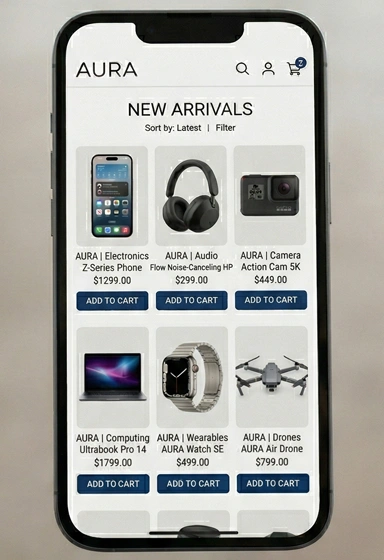
Most of your traffic will arrive on a phone and most abandoned carts happen there. We design the mobile experience first and scale up, rather than squeezing a desktop layout onto a small screen. Mobile-first ecommerce website design is now the baseline, not a feature.
An ecommerce website design is only finished when the back office works. Inventory, accounting, shipping and fulfilment, email marketing, and CRM connected so orders flow without anyone retyping them. Our ecommerce development services cover the integration work most design agencies hand back to you, and our ecommerce website development services include the testing to prove it works.
There is no single best ecommerce platform. Among the ecommerce platforms worth considering, the right one fits your catalogue, your team, and your budget. We build e commerce websites on all three below, and we handle ecommerce hosting so the store is fast from day one. For many retailers the best ecommerce platform for small business is simply the one their team can run.
Shopify suits most retailers who want to sell rather than maintain software, and seo shopify work is straightforward once the theme is built properly. Our Shopify website design work covers custom themes, Liquid development, app integration, and Shopify Plus for higher volume.
As a Shopify development partner we build custom rather than buying a theme and recolouring it, so your store does not look like the other hundred using the same ecommerce website templates. Shopify web design done properly is a custom theme, not a skin.
WooCommerce makes sense when you want to own the whole stack, need unusual functionality, or want to avoid per-transaction platform fees. Our WooCommerce website design keeps the extension stack lean.
Most slow WooCommerce stores are slow because of extension sprawl rather than anything inherent to the software. Built properly it performs perfectly well at scale, and WooCommerce development is often the cheaper long-term home for a growing catalogue.
When your model does not fit a platform, custom ecommerce development is cheaper long term than fighting one. Subscriptions, complex configurators, B2B pricing tiers, and multi-vendor marketplaces.
We will talk you out of this if a platform would do. Custom ecommerce website design is right less often than agencies pretend, though when it fits it fits completely.
B2B ecommerce website design covers customer-specific pricing, minimum order quantities, quote requests, purchase orders, and account-based catalogues. B2B ecommerce has rules consumer stores never deal with.
We build the approval and credit workflows your sales team already runs on paper.
A free ecommerce website from a hosted builder will take you a certain distance, and no further. You do not need enterprise architecture to sell forty products, but you do need to own the thing. We scope small business ecommerce to the catalogue you actually have, with room to grow when it earns the upgrade.
Flexible payment plans, because stock and a website compete for the same money in year one. If a hosted ecommerce website builder genuinely serves you better at this stage, we will say so.
If you have traffic but weak conversion, an ecommerce website redesign usually beats more advertising. We rebuild structure, checkout, and speed while keeping the rankings you already hold.
Most redesigns pay for themselves on conversion improvement alone, which makes an ecommerce website redesign the cheapest growth available to a store that already has traffic.
Design decides whether people trust your store. Ecommerce website development decides whether it works when a thousand of them arrive at once. Our e-commerce development covers both.
Our ecommerce web development services start with clean, semantic, fast-loading code rather than a stack of page-builder widgets. Our ecommerce web development produces stores that stay quick as the catalogue grows, which is the part most ecommerce development services quietly skip.
Product configurators, subscription billing, bundle pricing, loyalty schemes, and anything else your model needs. We write up the trickier builds on our blog if you want to see the approach first. As an ecommerce development company we build features rather than bolting on a plugin and hoping, and as an ecommerce web development company we maintain them afterwards. You get a named ecommerce website developer on the account, not a ticket queue.
Connecting your store to ERP, accounting, warehouse, and shipping systems so stock and orders stay accurate without manual work. This is where most ecommerce website development projects quietly run over, so our ecommerce website development company scopes it before quoting rather than after.
Two years of free maintenance with every build: security patches, platform updates, backups, uptime monitoring, and support when something breaks at the worst moment.
Moving between platforms is routine work done carefully, and a disaster done casually.
Shopify to WooCommerce, WooCommerce to Shopify, Magento or Wix to either. Replatforming is ordinary ecommerce website development work, not a special project. The reasons vary: transaction fees, functionality you have outgrown, or a platform your team cannot operate without calling a developer every week.
Moving an e commerce store between platforms carries one real risk, and it is never the design. It is the data. Products, variants, customer accounts, order history, reviews, and above all the URLs that currently rank. A migration that drops those sends your organic traffic to zero overnight, and recovering it takes longer than the migration did.
So we map every existing URL to its new destination, redirect them properly, migrate the data in staged test runs before the live switch, and keep the old store running until the new one is verified. You approve the go-live, not the calendar.
If you are weighing a move, the honest answer is sometimes to stay put and fix what you have. We will tell you which situation you are in before quoting, which is the least popular thing an ecommerce website design agency can say and the most useful.
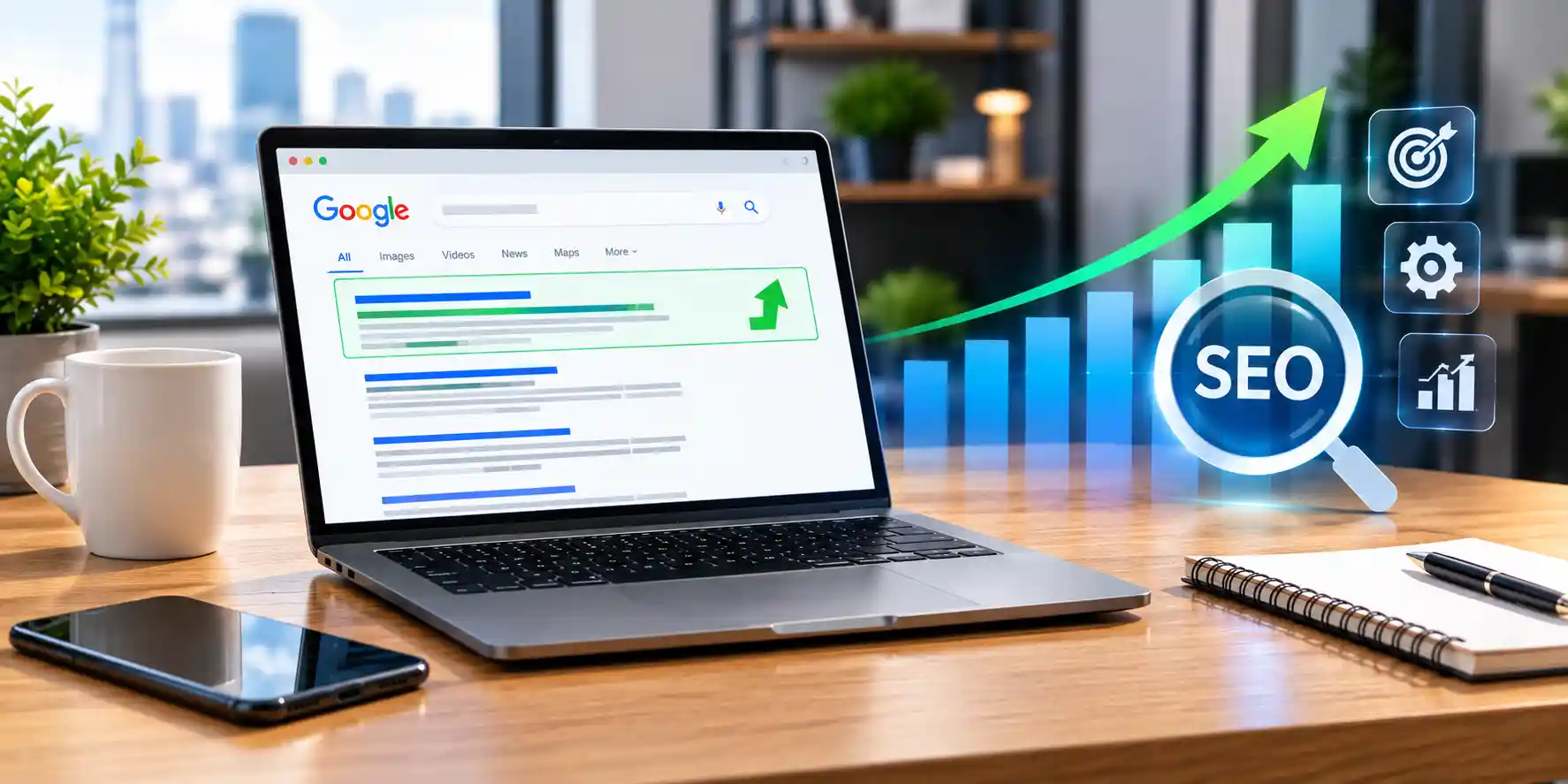
A store nobody finds is a very expensive catalogue. Search has to be designed in from the structure up.
Search engine optimization for ecommerce has problems ordinary sites never face. Thousands of near-identical product pages. Faceted navigation generating duplicate URLs by the thousand. Out-of-stock products deciding whether to redirect, keep, or remove. E commerce SEO lives or dies on these unglamorous decisions. Category pages carrying the commercial value while product pages get all the attention.
We handle all of it at build time: clean URL structure, canonical tags, product and review structured data to Google's specification, optimised category copy, and pagination that search engines can follow. E-commerce SEO built into the ecommerce website design costs far less than retrofitting it.
SEO for ecommerce websites then continues after launch as the catalogue changes. Our full SEO services cover ongoing ecommerce SEO for stores that want to keep growing organic revenue rather than renting it from ads, and as an ecommerce SEO company we also handle ecommerce marketing across email and paid where it earns its place.
Five stages with fixed checkpoints. Most stores launch in six to twelve weeks depending on catalogue size and integrations.
Products, margins, customers, competitors, and the systems you already run. Every ecommerce website design project starts here, and if you have an existing store we audit where the current one loses people.
Platform recommendation with the reasoning written down, plus category structure, URL plan, and the keyword map behind both.
Homepage, category, product, cart, and checkout designed and reviewed with you before any build begins. This is where the ecommerce website design takes final shape, and two rounds of revisions are included.
Development, payment gateways, shipping rules, inventory and CRM connections, then testing on real devices with real transactions.
Migration, redirects, analytics and ecommerce tracking, staff training, then conversion work on the ecommerce website design once real traffic shows where people hesitate.
Ecommerce website design cost depends on catalogue size, platform, and how much custom functionality and integration you need. A small store on Shopify with a modest catalogue sits far below a custom build with ERP integration and B2B pricing rules. Every project includes design, build, product upload, training, and two years of maintenance, and we quote a fixed figure after discovery. Tell us what you sell and you will get a real number.
Shopify if you want to sell rather than maintain software, and you can live with transaction fees and the platform's limits. WooCommerce if you need unusual functionality, want to avoid per-sale fees, or want to own the whole stack outright. For most first-time retailers Shopify is the faster route to revenue. We give you the recommendation with reasoning rather than a preference, and the ecommerce website design is custom either way.
Shopify hosts your store, handles security and payments, and charges a monthly fee plus a cut of each sale. You get reliability and no server maintenance in exchange for transaction fees and limits on deep customisation. It suits most retailers. If your margins are thin or your model is unusual, WooCommerce or a custom ecommerce website design will serve you better.
You can, and for testing whether a product sells at all it is a reasonable first step. The limits arrive quickly: weak SEO, a template thousands of other stores use, restricted checkout, and no real ownership. A free online store proves demand. It does not scale into a business. When it starts earning, move to a proper ecommerce website design before the platform caps your growth.
A straightforward store takes four to six weeks. Larger catalogues, custom functionality, or ERP and inventory integrations push it to eight to twelve. Migrations depend almost entirely on data quality in the old store. You get a timeline at the proposal stage and an update at every milestone of the ecommerce website design and build.
Yes. We migrate products, variants, customers, order history, and reviews, and we map every ranking URL to its new address with proper redirects. The old store stays live until the new one is verified. Losing search rankings is the main risk in any replatform, and it is entirely avoidable with URL mapping done before the move rather than after.
Yes. SEO for ecommerce websites is part of the build: clean URLs, canonical tags, product and review schema, optimised category pages, fast loading, and pagination search engines can crawl. We also offer ongoing SEO services for stores that want to keep growing organic traffic after launch.
Yes. You get a dashboard for adding products, editing content, running discounts, and processing orders without touching code, plus training and written documentation. Most clients run day-to-day themselves and call us for larger changes.
Yes. Product upload is part of the ecommerce website design package, whether from a spreadsheet, a supplier feed, or an existing store. For large catalogues we import in bulk and check a sample thoroughly rather than eyeballing twenty thousand rows. We will also tell you where your product data needs cleaning first, because no store performs well on bad data.
Stripe, PayPal, card gateways, mobile money, bank transfer, and buy-now-pay-later providers, plus multi-currency for international selling. We recommend based on your market and your margins, since gateway fees matter more than most retailers expect. Every method is tested with live transactions before launch.
Yes, and if you have traffic but poor conversion it is usually better value than a rebuild from scratch. An ecommerce website redesign addresses structure, checkout, speed, and trust signals while preserving the rankings and content that already work. It is the same ecommerce website design process applied to a store that already earns.
We scope the ecommerce website design to the catalogue you actually have. A focused store selling your best products well beats an ambitious one you cannot finish. Simplified packages and flexible payment plans are available, and we will be honest if a hosted ecommerce website builder would genuinely serve you better for now.
Tell us what you sell and who buys it. You will get a platform recommendation, a realistic ecommerce website design timeline, and a fixed quote before anything starts.